News

Indian Affairs imposes new Chief and Council on Barriere Lake

By • Aug 18, 2010

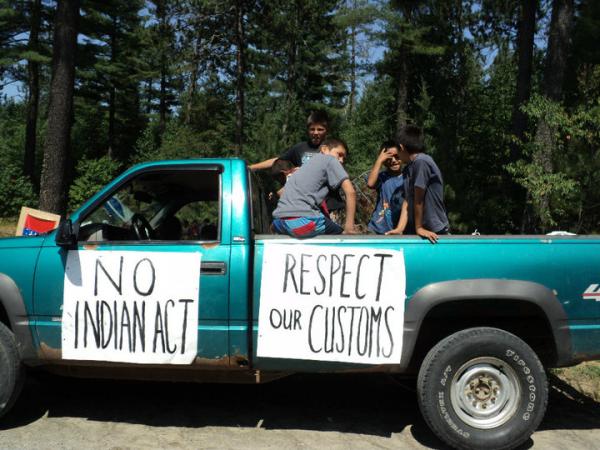
Photo: defendersoftheland.org

Indian and Northern Affairs Canada (INAC) went ahead this week with its draconian drive to impose a new Chief and Council in the Algonquin community of Barriere Lake.

According to Barriere Lake Solidarity, the government received somewhere between six and ten nomination mail-in ballots from a community of more than 450 people.

In effect, less than 2 percent of the community took part in the imposed election; But as far as INAC is concerned, six to ten was more than enough. On Monday, they declared that the new Band Council Chief was Casey Ratt, one of the Algonquins at the center of the community’s long-standing leadership dispute.

However, the acclaimed Chief has refused the position, stating that he does not want to “break ranks with the community’s broad opposition to the Indian Act band elections” says Barierre Lake Solidarity in a recent press release.

“The overwhelming majority of our community remains opposed to the Indian Act band election regime. Almost two hundred people signed a resolution in May rejecting it and supporting our traditional selection process. Does the Minister of Indian Affairs really think that the consent of a handful of people can let them get away with eradicating our system of government?” says Tony Wawatie, a spokesperson for the Algonquin community. “The government has lectured us about democracy. But how can this be democratic if it goes against the will of our entire community? This looks more like tyranny.”

Tyranny indeed. The government used an obscure provision from the Indian act known as Section 74 which let them impose an election regardless of what the community wants and regardless of their supposedly-protected constitutional rights; for instance, their right to self-government, which is defined in section 35 of the Canadian Constitution Act.

“The decision to impose section 74 band elections is an attack not only on our traditional system of government, but on our culture, language and way of life, which are all connected to our traditional system of government,” says Marylynn Poucachiche, another community spokesperson. “We will not accept it. Until our basic and legitimate rights are respected, we will escalate our actions, including not allowing any resource extraction within the Trilateral Agreement Territory.”

Publicly, INAC says it was compelled to use Section 74 because of the ageing leadership dispute between Casey Ratt and Norman Matchewan. The department says it simply had ‘no choice’, and that it was in the community’s best interests.

But this claim of goodwill and benevolence is more for ‘hearts and minds’ than anything else. After all, the government has been talking about a change in leadership since at least 2002, years before the dispute began.

The real reason for the government’s intervention, it is believed, is that Canada and Quebec want to get out of a set of binding agreements with the Barriere lake Algonquins, including the 1991 Trilateral Agreement which was “a landmark sustainable development agreement praised by the United Nations and the Royal Commission on Aboriginal Peoples. Canada has been in breach of the Agreement since 2001,” explains Barriere Lake Solidarity.

Norman Matchewan’s father and the formerly-recognized Chief of Barriere Lake, Jean Maurice Matchewan, tirelessly worked to ensure that both governments honoured the agreements.

And now that the election has concluded, thanks to Casey Ratt and almost the entire Algonquin community, INAC will go back to the drawing board. After all, they still have to impose a new Chief and Council in Barriere Lake. Odds are they’ll hold a by-election, but at this point there’s no telling what they’ll do or how far they’ll go… Especially if they’re going to just casually violate the Constitution like it’s just another day.

Media contacts:
Tony Wawatie, community spokesperson: 819 – 860-4121
Marylynn Poucachiche, community spokesperson: 819-441-4923

Or email to arrange interviews: barrierelakesolidarity@gmail.com

For more information and background: www.barrierelakesolidarity.org

  • John Ahni SchertowJohn Ahniwanika Schertow is an indigenous rights activist of Mohawk (Kanienkehaka) and mixed-European descent. For the past 8 years, he has served as the e... read full bio

10 thoughts on “Indian Affairs imposes new Chief and Council on Barriere Lake

  1. Pingback: Tweets that mention Indian Affairs imposes new Chief and Council on Barriere Lake | Intercontinental Cry -- Topsy.com

  2. donna green

    sad fact to bear, that all canadian first nations people are refugees in this country.
    That gives every first nation individual in canada the right to apply for refugee status doesn’t it?…imagine if every first nations person applied,,,that ought to shake up em up in the state capital.

    Reply
  3. Sam James

    Unfortunately nothing is as simple and straightforward as it appears. This community, under its customary selection process, has had no real band council for the past 4 years. Because of this, conditions on the reserve have gotten worse and worse. This community is impoverished and it’s at least in part as a result of lack of good governance on the reserve.

    Here’s an example. At one point, it shut down the community school as a means of protest, despite the fact that the school provided two meals a day to children in the community. For many children, this was the only place that they got a proper meal. Children were going hungry in the community.

    You have to look a bit deeper. Oppression does occur as a result of colonialism. But there also exist oppressive systems internal to oppressed groups and cultures. Just because a system of governance is “traditional”, doesn’t mean it isn’t oppressive.

    Reply
  4. Thunderbeing

    I had hoped that this new INAC leader from BC would bring about good change and a better relationship with INAC and the canadian government and my people thus far i have not seen any good changes just more draconion bullying.Well a great change is coming to the known world real soon then maybe the whiteman will finally see the errors of their ways.

    Reply
  5. c Gibson

    Falling for the Indian affairs new guidelines will take this community to ruins…Leadership and community standards are the glue holding this community together..traditonal leadership ignored will lead to an abandonment of natural law in their community. This will lead down the road of dependancy and loss of responsibility to their cultural structures… Without responsibilites the people will become addicted to disruptive social patterns…. this needs to be repelled or the upcoming generation will suffer greatly

    Reply
  6. Turtle Island Lady

    Kichi Migweetch for your comments. I am an algonquin woman who lives among my people on the land and reserve. Many outside observers of the ABL situation do not know the actual situation. The anishinabek of Rapid Lake (ABL) have had internal problems for over 2 decades of leadership governance îssues. There is no doubt within the algoqnuin nation that there is a problem of control..greed which stems from a certain croonies and consultants who have used for decades the “blood line“ customary system as a means to hold on to power of ABL affairs. The question must be asked…Why has this community gone through so many inner leadership problems´..`Simple…because there is a problem with the governance structure because rules are constantly changed in the way they operate and choose leaders..accomodating their eligibility list and having only 4 elders to have a final say on the governance…very questionable. It saddens me to hear of my friends from all groups discuss this. Some ignorant outside observers has an empathetic view of how ABL are intruded upon on the issue of governance…but one things for sure, THEY HAD TOO..Children are those affected by these internal battles. Rather than fixing the REAL issues..ABL chooses to fight themselves and INAC..where is the sence in that. So observers..before remarking …dig deep and see where the real problem lies..when you have outside consultants who have worked for decades in Rapid Lake without showing advancements…and the millions they have made..20 million to be exact..There is definately serious money up for grabs if they would continue with the old regime. This community should fix their problems once and for all. They are holding up big developpments in the nation.

    Reply
  7. Pingback: Underreported Struggles #41, August 2010

  8. Pingback: Update On The Situtation of the Algonquins Of Barriere Lake

  9. Pingback: Update On The Situtation Of The Algonquins Of Barriere Lake « The Speed of Dreams

Leave a Reply

Connect with us

Get our latest articles by email!


I blows my mind to witness this behavior from people's whom run this country and the USA! They ( the so called leaders of countries) should be the ones leading...
Not to mention the fact that Indigenous Peoples have specific needs that settler populations generally do not posses, like requiring access to specific land areas to maintain culture, language, the...
It's true in a sense--we're all indigenous to somewhere--however, there are fundamental differences between populations who identify as "indigenous" and those who no longer follow a traditional way of life....
There is a need to recognize that all people are indigenous to this planet. We are one human race beholden to the mother that nurtures us. We must unite under...
Well, I think, unfortunately, passive complaints of PM Harper selling our land & water for basically nothing, are getting nowhere. Time to move up the ladder of complaining. Watch your...
It is instructive to see how mental, spiritual and physical health coincide in the indigenous philosophy, while the progressive view remains trapped in a treatment rather than preventive mode. It...
Kia ora, I would like to say unless they, ( those who say no more Full- Blooded Maori), know the whakapapa of every single Maori in Aotearoa, they should just...
Mohawk??I stand and prepared to back my people at any and all cost...
Who are the Algonquin
The Algonquin people call themselves either Omàmiwinini (plural: Omàmiwininiwak) or the more generalized name of Anicinàpe. Many Algonquins still speak the Algonquin language, called generally as Anicinàpemowin or specifically as Omàmiwininìmowin. The language is...
Learn more about the and other Indigenous Peoples around the world

"In a media landscape made up of lies, flash, giant blind spots and corporatized sites of distraction, Intercontinental Cry is a trustworthy pathway to the truth where people who are committed to understanding Indigenous realities can gain insight and information to illuminate and activate their struggles."

Taiaiake Alfred
Professor of Indigenous Governance at UVIC and author of Wasáse
Hair of the Dog