Featured

Canada isn’t living up to its Treaty obligations or its responsibilities to First Nations

By • Mar 15, 2012

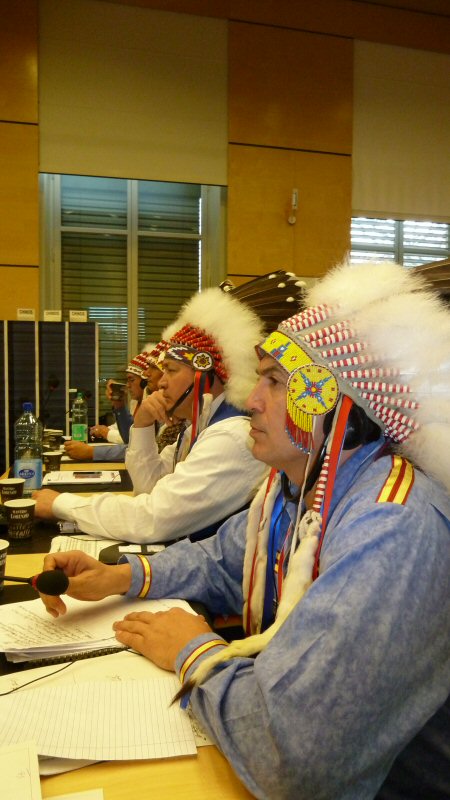
Chief Perry Bellegarde (r) and Chief Cameron Alexis contemplate Canada's presentation to the UN CERD in Geneva, Switzerland. - February 22, 2012

The Canadian government is being reminded once again of its obligations to Indigenous Peoples in Canada and its failure to live up to the standards of the International Convention on the Elimination of all Forms of Racial Discrimination (ICERD).

The UN Committee on the Elimination of Racial Discrimination (CERD)–following its Hearing last month in Geneva–has released an ‘advance unedited version’ of its concluding observations regarding Canada’s compliance with the legally binding treaty.

Those observations contain more than two dozen recommendations based on a review of Canada’s self-assessment and information provided by Indigenous Peoples and civil society organizations such as the First Nations Women Advocating Responsible Mining, Indigenous Bar Association, Treaty 4 First Nations, Union of British Columbia Indian Chiefs, Western Shoshone Defense Project, InterPares, the International Indian Treaty Council (IITC), the Tsilhqot’in National government and the First Nations Summit.

Those recommendations include:

  • The full implementation of treaties between Indigenous Peoples and the Crown (Canada);
  • Ensuring that Canadian-based transnational corporations do not cause human rights violations impacting Indigenous Peoples in other countries;
  • Implementing Free, Prior and Informed Consent regarding development projects impacting Indigenous Peoples lands; and
  • Creating a national plan of action to implement the United Nations Declaration on the Rights of Indigenous Peoples.

Concerning the actions of transnational corporations in other countries, The Committee urges Canada specifically to “Take appropriate legislative measures to prevent transnational corporations registered in Canada from carrying out activities that negatively impact on the enjoyment of rights of indigenous peoples in territories outside Canada, and hold them accountable.”

Canada had a prime opportunity for such legislation with Bill C-300–the Responsible Mining Bill–that was put forward by Liberal MP John McKay. Sadly, the Bill was defeated in Parliament by just 6 votes in October 2010.

The Committee also singled out Indigenous Peoples’ economic, social and cultural rights in Canada, recommending:

    Boiling water straight from a tap in Attawapiskat (2009)
  • Speeding up the provision of safe drinking water to Aboriginal communities on reserves;
  • Intensifying efforts to remove employment-related discriminatory barriers and discrepancies in salaries between Aboriginal and non-Aboriginal people, in particular in Saskatchewan and Manitoba;
  • Finalising the construction of homes for the Attawapiskat communities in northern Ontario, and facilitating access to housing by Aboriginal people, by adopting and implementing the plan currently being drafted;
  • Facilitating their access to health services;
  • Improving access to education of Aboriginal children including to the post-graduate education, in particular by generalising the Enhanced Prevention Focus, and providing it with sufficient funding;
  • Discontinuing the removal of Aboriginal children from their families and providing family and child care services on reserves with sufficient funding; and
  • Providing adequate compensation through an appropriate settlement mechanism, to all students who attended the Indian Residential Schools in order to fully redress the intergenerational effects.

The official spokesperson for Treaty 4 First Nations, Chief Perry Bellegarde, who was among the Indigenous representatives to participate in the Geneva hearings, welcomed the CERD report. Speaking to the Indian Country Today Media Network, he commented, “I was pleasantly surprised because a lot of the points raised were issues we talked about in Geneva.

Among the many issues raised was the massive discrepancy in the U.N.’s quality of life index, a discrepancy that is often ignored by the press. “Canada is rated number six, but if you apply the same statistics to Indigenous Peoples we end up being number sixty-three, so there’s a great socioeconomic gap between indigenous peoples and the rest of Canadian society,” Bellegarde said.

The Committee had another set of recommendations concerning violence against Indigenous women and girls and the continued murders and disappearances of Indigenous women across the country, another crisis that is frequently ignored. Here the Committee recommends

  • Strengthen its efforts to eliminate violence against Aboriginal women in all its forms by implementing its legislation and reinforcing its preventive programmes and strategies of protection, including the Shelter Enhancement Program, the Family Violence Prevention Program, the Policy Centre for Victim Issues and the Aboriginal Justice Strategy and the new National Police Support Centre for missing persons;
  • Facilitate access to justice for Aboriginal women victims of gender-based violence, and investigate, prosecute and punish those responsible;
  • Conduct culturally-sensitive awareness-raising campaigns on this issue, including in affected communities and in consultation with them;
  • Consider adopting a national plan of action on Aboriginal gender-based violence;
  • Consult Aboriginal women and their organisations and support their participation in development, implementation and evaluation of measures taken to combat violence against them.

Truth be told, this is merely the tip of the iceberg when it comes to Canada’s failings. But it is enough to say that if the Canadian government is serious about establishing a healthy relationship with Indigenous Peoples and living up to its claim of being a human rights leader, it must to implement the Committees’ recommendations.

Unfortunately, the odds are good that it won’t do so freely; a problem to which Danika Littlechild, Ermineskin Cree Nation and IITC Legal Counsel, responds: “It is important that we continue the momentum and ensure that Canada actually implements the recommendations of the CERD, especially those relevant to Indigenous struggles in Canada. The CERD has laid out a road map for progress on these issues, including calling for a formal mechanism for implementation.” W we have to compel Canada to go down that road.

To view the CERD’s Concluding Observations as well as the submissions regarding Canada, visit: http://www2.ohchr.org/english/bodies/cerd/cerds80.htm.

  • John Ahni SchertowJohn Ahniwanika Schertow is an indigenous rights activist of Mohawk (Kanienkehaka) and mixed-European descent. For the past 8 years, he has served as the e... read full bio

2 thoughts on “Canada isn’t living up to its Treaty obligations or its responsibilities to First Nations

  1. Pingback: Canada isn’t living up to its Treaty obligations or its responsibilities to First Nations | Mexika Resistance

Leave a Reply

Connect with us

Get our latest articles by email!


I blows my mind to witness this behavior from people's whom run this country and the USA! They ( the so called leaders of countries) should be the ones leading...
Not to mention the fact that Indigenous Peoples have specific needs that settler populations generally do not posses, like requiring access to specific land areas to maintain culture, language, the...
It's true in a sense--we're all indigenous to somewhere--however, there are fundamental differences between populations who identify as "indigenous" and those who no longer follow a traditional way of life....
There is a need to recognize that all people are indigenous to this planet. We are one human race beholden to the mother that nurtures us. We must unite under...
Well, I think, unfortunately, passive complaints of PM Harper selling our land & water for basically nothing, are getting nowhere. Time to move up the ladder of complaining. Watch your...
It is instructive to see how mental, spiritual and physical health coincide in the indigenous philosophy, while the progressive view remains trapped in a treatment rather than preventive mode. It...
Kia ora, I would like to say unless they, ( those who say no more Full- Blooded Maori), know the whakapapa of every single Maori in Aotearoa, they should just...
Mohawk??I stand and prepared to back my people at any and all cost...

"In a media landscape made up of lies, flash, giant blind spots and corporatized sites of distraction, Intercontinental Cry is a trustworthy pathway to the truth where people who are committed to understanding Indigenous realities can gain insight and information to illuminate and activate their struggles."

Taiaiake Alfred
Professor of Indigenous Governance at UVIC and author of Wasáse
Hair of the Dog