News

Barriere Lake Algonquins set up peaceful blockade

By • Jul 22, 2010

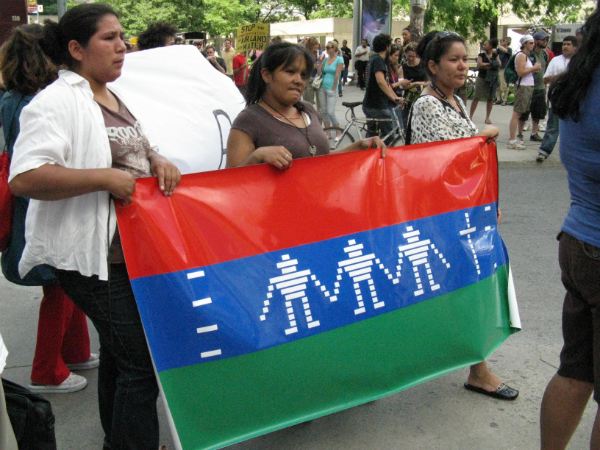
Three-Figure Wampum belt, dated back to around 1760, is an agreement between the Barriere Lake Algonquine, the Church and the settlers. The belt depicts an acknowledgement whereby, under the sign of the cross, no interference would be made into the local native ways of life. Photo c/o ipsmo.org

Early this morning, a group of Barriere Lake Algonquins set up a peaceful blockade on the access road leading to their reserve, about 300 km north of Ottawa.

The defensive action was aimed at stopping a government-appointed electoral officer from holding a nomination meeting on the reserve for the government’s highly-controversial imposed Band Council Election.

Below, a press release about the action from Barriere Lake Solidarity.

Barriere Lake Algonquins set up peaceful blockade to stop unconstitutional attack on their customary government; AFN passes emergency resolution condemning Minister Strahl

Kitiganik, Rapid Lake, Algonquin Territory / – This morning Barriere Lake community members set up a peaceful blockade on the access road to their reserve to prevent an electoral officer from conducting a nomination meeting for Indian Act band elections.

The electoral officer aims to implement the federal government’s plan to abolish Barriere Lake’s traditional leadership selection system by holding nomination meetings in the community for a band election imposed through section 74 of the Indian Act. Barriere Lake is one of the few First Nations in the country who have never been under the Indian Act’s electoral system, continuing instead to operate under a Customary Governance Code that they have used since time immemorial.

At its General Assembly in Winnipeg on Wednesday, the Assembly of First Nations passed an emergency resolution condemning Minister of Indian Affairs Chuck Strahl and demanding that he rescind the section 74 order to impose Indian Act band elections.

“We reject the Minister’s unconstitutional attempt to assimilate our leadership selection customs by imposing a foreign regime on us. The community is unanimously in favour of continuing to be governed by our customs,” says Marylynn Poucachiche, a community spokesperson. “Because the government has not heeded its constitutional obligations or our community’s wishes, we are turning to peaceful direct action. We will be preventing the nomination meeting from proceeding and are demanding the federal government immediately cease and desist in their attempt to abolish our customs. The government is breaking the law, but through our actions we are protecting it.”

Barriere Lake’s inherent right to customary self-government is protected by section 35 of the Canadian Constitution. A May, 2010 report by the Standing Senate Committee on Aboriginal Peoples affirmed that First Nations have the right to maintain control over their internal affairs and be free to pursue their vision of customary government.

“The Canadian government is trying to forcibly assimilate our customs so they can sever our connection to the land, which is at the heart of our governance system,” says Tony Wawatie, another community spokesperson. “They don’t want to deal with a strong leadership, selected by community members who live on the land, that demands that the federal and Quebec governments implement the outstanding agreements regarding the exploitation of our lands and resources.”

Under Barriere Lake’s customary governance code, participation in leadership selections is open only to those band members who live in the traditional territory and have knowledge of and connection to the land. This ensures that people who have a stake in the land and it’s health select leaders. But Indian Act band elections would open voting to individuals on the band registry list who do not live in the community’s territory.

The federal government has slightly delayed the date for the Indian Act band elections, announcing they will try to hold them on September 8, 2010.

-30-

Media contacts:
Tony Wawatie, community spokesperson: 819 – 860-4121
Marylynn Poucachiche, community spokesperson: 819-441-4923

Send a letter in support of Barriere Lake’s indigenous rights: http://barrierelakesolidarity.blogspot.com/2007/10/blog-post.html


  • John Ahni SchertowJohn Ahniwanika Schertow is an indigenous rights activist of Mohawk (Kanienkehaka) and mixed-European descent. For the past 8 years, he has served as the e... read full bio

9 thoughts on “Barriere Lake Algonquins set up peaceful blockade

  1. carol louie

    I am glad they barrierre lake people are making a stand. They abolished heridary leadship on this reserve in Vernon, British columbia in in 1922. The present elected indian act cheif/council are corrupt. Don’t ever let them win or make a change for your tradional people will really suffer like we do over here. It’s awful here on my reserve.

    Reply
  2. Thunderbeing

    The government tried the same thing with the Lubicons but that was over putting a industry friendly native government into play because of transcanada attempted theft of Lubicon land.I stand firmly with you good people of Barrier lake,i pray you get all that you wish.I hope the government don’t force a powerful intervention from our ancestors,for that is what will happen if the police get violent with you guys like they did that time with the tear gas canaster and the three year old.Things are different now they know they will be punished severly if they harm you now.I hope this ends with a good peaceful resolution i admire your courage out there,for what they did that one time still ires me to this day.

    Reply
  3. Warren McBride

    You have a great deal of support from many people here in Ottawa. The emails to the INAC Minister are increasing. Keep up the courage.

    Reply
    1. Tony Wawatie

      INAC is still coming in on august 12 (nomination date) to force Section 74 Indian Act Electoral System. INAC will be backed up by the Quebec Provincial Police and are threatening to make arrests if we interfere. This is very wrong and we need support. This is a national cry for help! Check out our blog spot for informationa and contact!

  4. Lorne

    Is this the same thing that is happening to the Lubicon Nation in Alberta? INAC is refusing there to recognize the traditional government as well. The Edmonton Journal recently made mention of INAC possibly using Section 74 to force INAC elections upon them as well. Does anyone know if this is INACs new strategy for First Nations that are outside Treaty and use Custom Code Elections?

    Reply
  5. Thunderbeing

    It is similar yes Lorne,but with the Lubicon its over industry friendly controllable counsel,with Barrier lake it could be similar maybe logging we’ll.I am monitoring all these situations closely Barrier lake Lubicons and a few other problems threwout Canada.That though is another reason why this white Canadian government is having a hard time sighning the indian declaration of independence even though every other country in the world has minus Canada and America.It says on the declaration that we control our own lands and resources.When the Canadian and American government have stolen our lands since their violent and decieving arrival here and to this day sell our lands under our feet to the destroyers ie industry and mining. It is also a matter of control over us,but that will soon change when our ancestors come back.

    Reply
    1. Ahni

      Yes, aside from a few details, the situations are pretty much the same. Especially because, in both cases INAC is trying to take advantage of the divisions caused by the two disputes (while hiding under the cloak of benevolence). On the community level, though, there is one big difference at this point: The Algonquins have put aside their differences to stand up to INAC. This hasn’t quite happened with the Lubicon yet. But if what you say is true, Lorne, then it definitely needs to.

      About INAC’s strategy, I haven’t seen anything on paper, but Canada has always wanted to replace traditional governments with something they can control (directly or indirectly) … That’s exactly why they developed and imposed the Band Council system. But they never had the chance to bring Barriere Lake and the Lubicon (along with most Nations in BC; and, of course, Six nations, among others) into that “fold”. So they’ve literally been waiting like a pack of wolves for a moment of weakness. Now that they see some, they’re taking a few steps forward. And if there’s no resistance, they’ll take a couple more (or, if there is resistance, they’ll try to jump). It’s the same thing Canada has always done.

  6. bik

    good now that you actually have self government, make your own currency, stop asking for money from the canadian government, then learn about taxation, build your own shit and stop freeloading of the settlers who built this country and died for it.

    Reply

Leave a Reply

Connect with us

Get our latest articles by email!


Kia ora, I would like to say unless they, ( those who say no more Full- Blooded Maori), know the whakapapa of every single Maori in Aotearoa, they should just...
Mohawk??I stand and prepared to back my people at any and all cost...
I have worked with, lived with, and been around Copala Triquis for the past 12 years, and have researched extensively the political oppression in teh region - ever since the...
Thank you for your comment, trog69. You might have seen my update http://intercontinentalcry.org/wall-street-tea-party-convergence-19421/ on the story, including a link to a special report by Charles Tanner, titled Take these Tribes Down....
Good afternoon, Mr. Taber. I must admit that part of my astonishment upon reading about this is my complete ignorance that there is a concerted effort to take the rest...
Thank you, David. While it's good that some elected officials are joining environmentalists and tribes in opposing Gateway Pacific Terminal, the Tea Party, AFL-CIO and anti-Indian property rights activists have...
Seattle Mayor Mike McGinn comments on proposed coal trains and export terminals: http://www.youtube.com/watch?v=kOi4iEsSl_k...
Thanks for commenting, Laura. Do you have more information about that? If so, please get in touch info(at)intercontinentalcry.org...
Who are the Algonquin
The Algonquin people call themselves either Omàmiwinini (plural: Omàmiwininiwak) or the more generalized name of Anicinàpe. Many Algonquins still speak the Algonquin language, called generally as Anicinàpemowin or specifically as Omàmiwininìmowin. The language is...
Learn more about the and other Indigenous Peoples around the world

"In a media landscape made up of lies, flash, giant blind spots and corporatized sites of distraction, Intercontinental Cry is a trustworthy pathway to the truth where people who are committed to understanding Indigenous realities can gain insight and information to illuminate and activate their struggles."

Taiaiake Alfred
Professor of Indigenous Governance at UVIC and author of Wasáse
Hair of the Dog