News

Awajun and Wampis Detain Gold Mine Employees

By • Dec 2, 2009

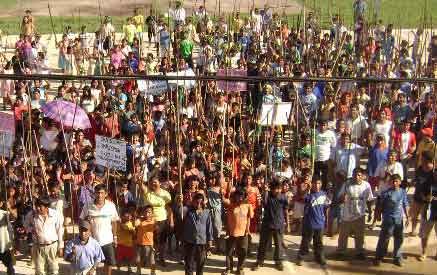
The Awajun and Wampis people in Bagua, Peru, recently detained employees from the Canadian mining company IAMGOLD.

According to statements from AIDESEP, the company did not have any authorization to enter the territory. The employees, five in total, were arrested in protest of the fact.

The workers were identified as Victor Raul Lipa Salas, Eduardo Duffó Victor Ochoa, Julio Alberto Cajo Manayay, Wilson Wilman Diaz and Felipe Barrios Llambo Gavidia. Another three workers from Dorato Resources Inc., another Canadian mining company, were also detained.

The action comes three months after Dorato Resource also illegally entered the Awajun and Wampis’ territory. At the time, Peru’s congress had just decided to repeal two of the controversial laws that led to 90 day mobilization which culminated on June 5 in Bagua.

There is, however, one major difference between Dorato and IAMGOLD’s excursions. Only Dorato had the government’s permission to enter the Awajun and Wampis’ territory. According to Peruvian Ministry of Energy and Mines, IAMGOLD did not.

Felipe Ramirez, a Director for the ministry’s Environmental Affairs office, recently stated that IAMGOLD hasn’t even so much as asked the govenrment for a permit to mine or explore for minerals in the region. “What they are doing is illegal,” the official stated.

IAMGOLD denies any kind of wrongdoing on their part. In fact, they’ve even gone so far as to say that one was arrested.

Instead, the company alleges, the group of employees were on “the property of a willing third party individual,” when they were told to leave, presumably, by the Awajun and Wampis.

Being noble protectors of good will and justice–something all Canadian companies are professing to be these days—the employees conceded to the Awajun and Wampis request, picked up their gear and left.

Regardless of what actually happened here, the fact is IAMGOLD should have never been on the Awajun and Wampis territory. And they would have stayed there if they were never confronted.

In effect, it is one brief example of how Canadian companies routinely operate in Peru and in dozens of other regions around the world. These companies go to great lengths to portray themselves as both victim and faultless champion, while disregarding even the most basic laws, human rights, and so-called voluntary corporate social responsibility (CSR) standards.


  • John Ahni SchertowJohn Ahniwanika Schertow is an indigenous rights activist of Mohawk (Kanienkehaka) and mixed-European descent. For the past 8 years, he has served as the e... read full bio

8 thoughts on “Awajun and Wampis Detain Gold Mine Employees

  1. Billy Jack Douthwright

    Good for them & they should do so more often– everywhere in the world that ‘Canadian’ mining companies operate, beginning in ‘Canada’.

    Reply
  2. Amazonas Indigena

    Amazonia For Sale
    http://www.dailymotion.com/video/xcdem0_amazonia-for-sale_news

    Excellent documentary in English, of Ore-Media and IWGIA explaining the situation in the Peruvian Amazon and the defense of territory and peoples Wampis and Awajun.

    The Awajún people and their struggle to protect their ancestral territory.
    The Awajún people have inhabited the Amazon rainforest since time immemorial, living in harmony with – and respectful of – nature. This ecological balance is now being threatened by a growing interest on the part of the Peruvian government and national and international companies in indiscriminately exploiting the area’s mineral, timber and oil resources.
    As a result of this plan, promoted by the state in the name of progress and economic development, the original inhabitants of these lands are now threatened by pollution, illness and desertification.
    This documentary tells the story of the Awajún people’s resistance and struggle for their dignity and territory, both now and in the future, seeking to avoid the tragic experience to which many of Latin America’s native peoples have already succumbed

    Reply
  3. Pingback: Briefing on the Human Rights and Environmental Abuses of Canadian Corporations

Leave a Reply

Connect with us

Get our latest articles by email!


Kia ora, I would like to say unless they, ( those who say no more Full- Blooded Maori), know the whakapapa of every single Maori in Aotearoa, they should just...
Mohawk??I stand and prepared to back my people at any and all cost...
I have worked with, lived with, and been around Copala Triquis for the past 12 years, and have researched extensively the political oppression in teh region - ever since the...
Thank you for your comment, trog69. You might have seen my update http://intercontinentalcry.org/wall-street-tea-party-convergence-19421/ on the story, including a link to a special report by Charles Tanner, titled Take these Tribes Down....
Good afternoon, Mr. Taber. I must admit that part of my astonishment upon reading about this is my complete ignorance that there is a concerted effort to take the rest...
Thank you, David. While it's good that some elected officials are joining environmentalists and tribes in opposing Gateway Pacific Terminal, the Tea Party, AFL-CIO and anti-Indian property rights activists have...
Seattle Mayor Mike McGinn comments on proposed coal trains and export terminals: http://www.youtube.com/watch?v=kOi4iEsSl_k...
Thanks for commenting, Laura. Do you have more information about that? If so, please get in touch info(at)intercontinentalcry.org...
Who are the Awajun
Located in the Peruvian Amazon, the Awajún (sometimes referred to as Aguaruna) have a reputation for being some of the most skillful warriors in South America. They successfully defended their land from the Incas and...
Learn more about the , and other Indigenous Peoples around the world

"In a media landscape made up of lies, flash, giant blind spots and corporatized sites of distraction, Intercontinental Cry is a trustworthy pathway to the truth where people who are committed to understanding Indigenous realities can gain insight and information to illuminate and activate their struggles."

Taiaiake Alfred
Professor of Indigenous Governance at UVIC and author of Wasáse
Hair of the Dog