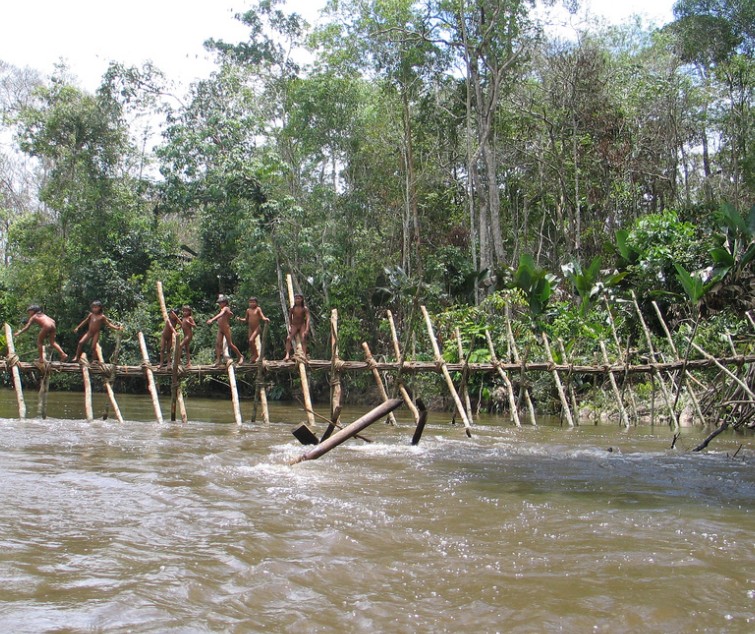
The Enawene Nawe in Brazil’s Mato Grosso state, recently began the Yãkwa, an important seasonal custom that provides the Arawak-speaking people with all the fish they will need throughout the year. Since 2009, the Enawene Nawe have been unable to complete the Yãkwa, because of an alarming lack of fish in local rivers.
Upstream from the Enawene Nawe’s territory, the Mato Grosso state government is constructing five new hydroelectric dams. The Enawene Nawe have been trying to prevent the construction–even going so far as to destroy a construction site in 2008–unfortunately, their efforts have only managed to delay construction.
If five hydro dams weren’t bad enough for the Enawene Nawe, the state government wants to build more than 70 other dams throughout the Juruena River Basin. If these dams go ahead, the Enawene Nawe fear they will permanently lose their customs and their subsistence way of life. Survival International reports.
The Enawene Nawe tribe of Brazil have begun their unique annual fishing ritual, amid fears that the 80 dams planned for the Juruena river basin are destroying their fish.
The tribe’s extraordinary ‘Yãkwa’ ritual is recognized by Brazil’s Ministry of Culture as part of the country’s cultural heritage. But in 2009, for the first time, the ritual could not be practiced, as the tribe found almost no fish in the rivers.
The Enawene Nawe faced a catastrophic food shortage, and the dam construction company was forced to buy three thousand kilos of farmed fish for the tribe.
In 2010 fish numbers were again low.
Some of the planned dams are funded by the Grupo André Maggi company, one of the world’s largest soya producers.
During the Yãkwa ritual the Indians spend several months in the forest, building intricate wooden dams across rivers to trap fish, and smoking the fish before taking them to their villages by canoe.
Yãkwa is a vital part of the Indians’ spiritual culture, and crucial for their diet, as, almost uniquely, the tribe does not eat meat.
In a letter to the UN, the Enawene Nawe say, ‘We don’t want the dams dirtying our water, killing our fish, invading our lands.’
The tribe did not give their consent for the dams. They have mounted blockades and invaded a dam construction site, warning that the dams would cause irreversible damage to their way of life.
Survival’s Director, Stephen Corry, said today, ‘It is a bitter irony that while Yãkwa is now recognized as part of Brazil’s cultural heritage, the ritual could very soon cease to exist. The Enawene Nawe’s entire way of life is in jeopardy.’
Read the Enawene Nawe’s letter to the UN ( PDF in English, Enawene Nawe, and Portuguese).
Write a letter for the Enawene Nawe! Visit http://www.survivalinternational.org/actnow/writealetter/enawenenawe

Indigenous Peoples are putting their bodies on the line and it's our responsibility to make sure you know why. That takes time, expertise and resources - and we're up against a constant tide of misinformation and distorted coverage. By supporting IC you're empowering the kind of journalism we need, at the moment we need it most.