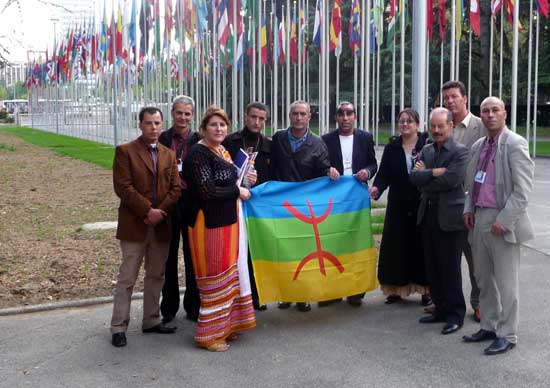
The International Federal Council (CF) of the World Amazigh Congress (Congrès Mondial Amazigh, CMA) recently held its 7th annual meeting in Marrakech, Morocco, to discuss the current state of Amazigh rights.
Founded in 1995, the CMA is an umbrella organization that represents the Imazighen, Indigenous Peoples more commonly known as the Berbers and the Tuareg. The Imazighen inhabit a vast territory in North Africa which stretches from the Oasis of Siwa in Egypt, through Libya, Tunisia, Algeria, Morocco, the Canary Islands and the Sahara desert to the north of Niger, Mali, and Burkina-Faso.
Among the Federal Council’s many observations at the meeting, they note that, in Libya:
“The Khadafi regime… continues to follow its apartheid politics towards Imazighen, depriving them of their language and culture, and threatening them with death when they claim their Amazigh identity. Three Libyan citizens have particularly been targeted by this racist state of Libya: the Amazigh singer Abdellah Ashini, unjustly accused of advocating illegal immigration to Europe, who was arbitrarily condemned to five years of prison, and Mazigh and Madghis Bouzakhar, both arrested in their Tripoli home, for having, it seems, had a scholarly conversation with an Italian citizen. To this day, the location where the two brothers are being held prisoners remains secret.
“In Libya, thousands of Tuaregs who originally came from the north of Mali and Niger and live in the south of Libya (Ubari, Sebha, Murzuq) have not been granted Libyan citizenship and are seriously discriminated against: they do not have any right to decent lodging, or to access to higher education, (reserved for Libyan citizens), or to open a bank account, or get a passport. They constitute a marginalized illegal population which is kept hidden from foreign visitors, as citizens of a third category.
“Moreover, the Libyan regime uses both corruption and terror to push certain Tuaregs to publicly renounce their Amazigh identities and declare themselves “Arabs.” Thus, the Libyan State pretends to be the leader of African unity, but dangerously manipulates ethnic factors to sow division and conflict between peoples . CMA is outraged by such practices of another era, and emphatically condemns the marginalization and repression burdening all Imazighen in Libya. CMA demands the immediate freeing of political prisoners and the end of anti-Amazigh racism in Libya.”
Concerning Amazigh rights in Morocco, the CF denounced the incarceration of Chakib El-Kheyari, a member of CF/CMA, stating:
“It is a flagrant injustice, for Chakib simply acted as a lawful citizen and defender of human rights when he uncovered the drug traffic and the corruption in which are implicated high ranked officers of the army, the police and Moroccan authorities. It is abnormal to condemn an innocent man while letting outlaws live in freedom. Also, members of CMA condemned the imprisonment of young members of the Amazigh cultural movement, who were subjected to a highly unfair trial. It is time for Morocco to abandon its repressive measures of the black years and to free political prisoners Chakib El-Kheyari, Mustapha Oussaya and Hamid Ouadouch.
They also denounced “serious violations of fundamental liberties and the abrogation of rights” in Algeria; the “Politics of denial of Amazigh identity and forced assimilation” in Tunisia; and, in the Canary Islands, reaffirmed their support of the local indigenous population which “continue[s] to be subjected to Spanish colonization which deprives them of the wealth of their natural resources and of its socio-cultural identity.”
Finally, the CF took note of the Tuareg’s ongoing struggles in Mali and Niger, stating:
“In Tuareg territory, notably in Niger and Mali, promises outlined in the several accords signed between Tuareg representatives and governments, since the beginning of the 1990’s, have been essentially ignored. Tuareg people are surviving between the anvil of drought and the hammers of states and multinational corporations which occupy their territories and ruthlessly exploit their natural resources. When Tuaregs attempt to organize in order to warn of danger, State authorities are always prompt to suppress these efforts violently, as it happened last October in the north of Mali when Tuareg youth attempted to gather in Timbuktu. Police intervened to bring an end to their gathering and two of them, Moussa Ag Acharatoumam and Boubeker Ag Fadil, were arrested and detained in police custody in Bamako for seventeen days during which they were subjected to brutal treatment, insults and threats. CMA denounces such abuse of power and calls upon the international community to come forth with concrete support of the Tuareg people of the desert, who are under threat of extinction.”
Overall, the Federal Council concurred that, “if some official pronouncements in international venues… appear to be favorable to human rights, they do not in fact reflect a reality which negates and obscures the Amazigh identity, as well as serious violations of elementary human rights or fundamental liberties of Imazighen, individual and collective.”
Download the CMA’s Report, https://intercontinentalcry.org/wp-content/uploads/Annual-meeting-of-the-Federal-Council.pdf. Thanks to Helene Hagan for forwarding the report to intercontinentalcry.org.
Visit the CMA’s official website at http://cmamazigh.com
Learn more about the Imazighen at the Tazzla Institute for Cultural Diversity, http://tazzla.org; and the Amazigh Cultural Association in America ,http://tamazgha.org

Indigenous Peoples are putting their bodies on the line and it's our responsibility to make sure you know why. That takes time, expertise and resources - and we're up against a constant tide of misinformation and distorted coverage. By supporting IC you're empowering the kind of journalism we need, at the moment we need it most.