The Algonquins of Barriere Lake is a 41-minute documentary that illustrates the Algonquin community’s decades-long struggle to have their land and resource rights recognized by Canada and the Province of Quebec. You can find the video below…
On June 26th, Algonquin representatives and supporters from the Barriere Lake Solidarity Collective peacefully occupied the offices of Barriere Lake MP Lawrence Cannon.
The aim of the occupation, at least primarily, was to demand the MP meet the Algonquins to discuss the recent “Coup D’etat” involving Barriere Lake’s Tribal Council.
During their 2006 election, Jean Maurice Matchewan was re-elected Customary Chief, “but a small faction ran a parallel leadership selection, claiming to have adhered to the Customary Governance Code,” writes Martin Lukas of Barriere Lake Solidarity. “Indian Affairs refused to recognize Matchewan, and then put the community under Third Party Management – which mandates that an external consultant unilaterally run the community’s finances and funding – claiming it was justified by Barriere Lake’s large deficit and leadership uncertainty.”
However, the aggressive move was more likely because the government simply doesn’t like Matchewan — a fact that Matchewan himself pointed out in a March 2007 Press Release.
“They did the same thing to me in 1996, when I was the Chief at that time. They don’t like me because I refuse to bow down to them,” referring to the near-unprecedented Trilateral Agreement he signed with Canada and Quebec, 17 years ago. The federal and provincial governments rue the day they agreed to that.
More pressing, however, there are a number of problems in the Algonquin community which needed (and still need) to be addressed. For one, Barriere Lake’s “school teachers have been replaced with teachers who do not speak Algonquin, and the curriculum has been changed to eliminate traditional teachings,” points out a detailed report of Barriere Lake’s current situation (pdf). “Other services have deteriorated as well. For example, fires now go unextinguished as TPM routinely neglects to fill the fire truck with fuel.”
As a form of peaceful protest, roughly 80% of the community has stopped accepting services from TPM. This means no school, no medical centre, no maintenance, and no day care for most of the residents. In retaliation, TPM recently ordered the Sûreté du Québec (SQ) to change the locks on all community buildings to the exclusion of local residents. This includes the band office, community centre, fire hall, gymnasium, and more.
Turning back to the June 26 action, Lia Tarachansky of the Dominion Paper followed the events as they unfolded. Rabble TV also conducted a set of interviews leading up to it. See the previous link, or watch it on youtube
As for Lia’s report, she initially statedr that the Solidarity Collective as well as Algonquin representatives “vowed they [would] not leave the office until their demands are met.” She continues,
Algonquin media liaisons inside the office occupation were unreachable, but Django, a spokesperson of the Solidarity Collective answered a few questions. Speaking to the situation on the ground he noted that “on the inside the police have asked some of the people to leave peacefully. There were three people that left [because they] weren’t willing to be arrested. [Those were] a cameraman and two Algonquins.” When asked what he predicts will take place later in the day, he replied “we’re still waiting for the demands to be met. The office normally closes at 4:00 p.m. or 4:30 p.m. so we’re thinking that’s probably the time [the police are] going to try and do the arrests.”
Sure enough, the SQ made their move by the end for the office day — arresting six in total. Fortunately, there were no incidents of violence to report — certainly nothing compared to the police assault on the Algonquin two months earlier, when the SQ “pepper sprayed children, pregnant mothers, and other vulnerable members without regard to their health or safety.”
Instead, the arrestees were brought to the Gatineau Police Department, where they stayed until their release at 9:30 that night, “into the arms of cheering family and friends”, Lia writes in a second report (and as you can see in another video covering the arrests.
While this action was short lived, the Algonquins of Barriere Lake are at the point where they cannot sit idely by — not as long as the two governments push an aggressive policy that impoverishes and divides them. And so, in the months ahead, let’s hope their support-base continues to grow — and moreso that community can find a way to heal the wounds Canada has inflicted on them. If they cannot do so, then there’s really nothing to stop Canada from inflicting a thousand more wounds.
The Algonquins of Barriere Lake
- Watch on Google
- Listen to interview with Martin Lucaks and Russell Diabo, Policy Advisor to Barriere Lake.
- visit barrierelakesolidarity.blogspot.com for more background

Unless otherwise indicated, articles on this site are licensed under a
from CCAMU July 14, 2008 http://www.ccamu.ca/
6) 3-DAY OTTAWA/GATINEAU PICKET IN SOLIDARITY WITH THE ALGONQUINS OF BERRIERE LAKE
NO COUPS D’ETAT in ALGONQUIN TERRITORY
HANDS OFF BARRIERE LAKE
HONOUR SIGNED AGREEMENTS
******************************
WHERE: Lawrence Cannon’s office at the Ministry of Transport
330 Sparks Street, OTTAWA, near the corner of Wellington and Kent
WHEN: Wednesday July 16 12:30pm-5pm and Thursday July 17 10:00am-5pm
WHERE: Department of Indian Affairs, Corner of Wellington and Montcalm in GATINEAU
WHEN: Friday, July 18 11:00am-5pm
*******************************
* This is a peaceful demonstration in support of Barriere Lake community members who are in Ottawa to demand a meeting with their riding MP Lawrence Cannon, a leadership re-selection in accordance with their Customary Governance Code, which has been blatantly violated by the Federal Government, and that the Federal Government respect all signed agreements with the community.
* Bring banners, signs, placards, noise-makers…
MORE INFO: barrierelakesolidarity.blogspot.com
CONTACT: barrierelakesolidarity@gmail.com
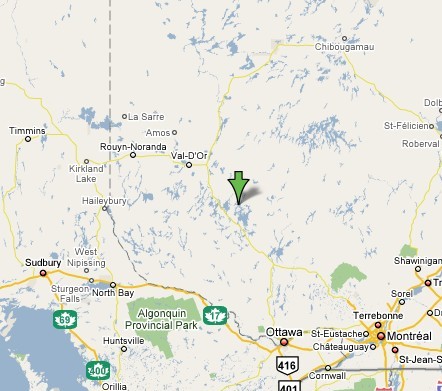
For twenty difficult years, the small Algonquin community of Barriere Lake, 3 hours north of Ottawa, has been struggling to hold the government to their word. In 1991, they signed a landmark resource co-management and sustainable development agreement with Canada and Quebec to protect Algonquin land uses, conserve the forest and wildlife, and give them a share in the resource revenue from the logging and hydro projects on their traditional territories. Corporations extract $100 million a year — Barriere Lake receives nothing.
The Canadian government walked away from the agreement in 2001. To avoid fulfilling their obligations, the Federal Department of Indian Affairs has ousted the Customary Chief and Council and illegally appointed a minority faction as the leadership, in an attempt to scrap the agreement. Despite knowledge of his government’s illegal actions, Minister of Transport Lawrence Cannon, Harper’s Quebec lieutenant and MP in Barriere Lake’s riding of Pontiac, has not ensured the federal government complies with the law.
* Despite several Quebec Hydro dams on their territory, the community is forced to use aging diesel generators to provide power.
* The housing crisis in the community has reached tragic proportions, with most living in moldy, often condemned houses. As many as 18 people live in one house.
* The Surete du Quebec has been used to forcibly impose and maintain the authority of the government-backed Chief and Council, supported by a community minority.
* Children have been prevented from speaking Algonquin in school by teachers hired by Third Party Management—a grim throwback to residential schools.
Join us in Ottawa and Gatineau, and support the community as it demands that the government respect the law and uphold their agreements.
BACKGROUND
From Arthur Manuel’s Submission to the United Nations Permanent Forum on Indigenous Issues, 7th Session, New York, April 21 – May 2, 2008
For entire submission: http://barrierelakesolidarity.blogspot.com/2008/04/canada-quebec-condemned-before-un.html
INTRODUCTION
• The Algonquins of Barriere Lake have a population of about 450.
• They have a 59 acre Indian Reserve that was set aside in 1962.
• The housing situation is critical, most of the 60 houses have been condemned by Health Canada for mould infestation, yet the houses are overcrowded with 8 to 18 people living in one house. Quebec’s Youth Protection Agency is refusing to allow infants to return to the community from the hospitals because of the poor housing conditions.
• The unemployment rate is about 80 to 90%.
• The federal government has mismanaged the community’s education services, one study has shown serious age-grade deficiencies under the federal administration of the school.
• The community is one of the last in Quebec who depend on diesel generators for electricity. These generators are operating at full capacity so no no houses or buildings can be added to the community grid.
Despite the poor social and economic conditions, the Algonquins of Barriere Lake have maintained their language, culture and customary system of government.
FEDERAL INTERFERENCE IN LEADERSHIP SELECTION PROCESS
Over the last 12 years the government of Canada has interfered in the internal affairs of the Algonquins of Barriere Lake three times.
In 1996-97 the Canadian government imposed an outside group as the Chief and Council. The federal government had to reverse its decision and recognize the legitimate customary Chief and Council on April 17, 1997.
In 2006, the federal government refused to recognize the legitimate Chief and Council during a new leadership selection process.
It took the intervention of a Quebec Superior Court Judge, Rejean Paul, who issued a mediation report in May 2007, confirming the legitimacy of the Customary Chief and Council, the Canadian government subsequently had to respect the community’s leadership selection.
However, on March 10, 2008, the government of Canada once again recognized a Chief and Council who according to the Barriere Lake Elders were not selected by the community in accordance with the community’s customs.
The Barriere Lake Elders’ Council has launched a court action against the federal Minister of Indian Affairs, Chuck Strahl, to have the Minister’s decision to change the Chief and Council overturned. The Department of Indian Affairs even refuses to release the information they based their decision on, to the Barriere Lake Elders. Even though the Barriere Lake Elders are responsible for overseeing leadership selection under their customs.
Not only is there a flagrant disregard for Indigenous customs regarding leadership selection, but the federal government is using the Quebec police force to install the federally imposed Chief and Council, even though the majority of the people do not agree to recognize the federally imposed group as their leaders.
The result of the federal imposition of an unaccepted Chief and Council has led to problems with the delivery of programs and services and confusion around who is the legitimate leadership.
REMOVAL OF INDIGENOUS PEOPLES FROM TRADITIONAL TERRITORIES
The federal government is trying to replace the legitimate customary Chief and Council just as negotiations were to start on implementing three major precedent setting agreements the Algonquins of Barriere Lake had entered into with the governments of Canada and Quebec.
In 1991, the Algonquins of Barriere Lake convinced the governments of Canada and Quebec to sign a Trilateral Agreement establishing a pioneering land management planning process based upon the Brundtland Report’s concepts of sustainable development, conservation strategies and that Indigenous Peoples have a ‘decisive voice’ over land use decisions that affect them.
Further agreements were signed with the governments of Canada and Quebec but the governments have continued to try and to get out of their obligations and liabilities under these agreements.
Now, the Canadian government has breached Barriere Lake’s governance customs and replaced their Customary Chief and Council with a federally imposed Chief and Council, in yet another effort to get out of the signed agreements,, because of the precedent setting nature of these agreements.
CONTRAVENTIONS
In contravention of the Declaration on the Rights on Indigenous Peoples and the signed agreements with the community, the federal and provincial governments are collaborating on promoting infighting within the community while refusing to honour signed agreements, which contributes to the poor social and economic conditions in the community.
From this case and other like KI, it appears there is a pattern in Canada to remove the Indigenous Peoples from their traditional lands to allow for unfettered corporate resource access and exploitation of forests, minerals, oil & gas and hydro projects.