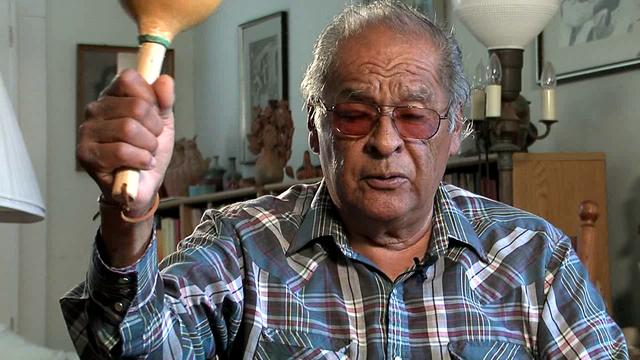
Songs of the Colorado tells the story of the traditional songs of the Yuman-speaking people and how those songs connect them, through story, language and history.
At least 10 Indigenous Peoples along the Colorado River speak the Yuman language, including the Cucapa, Havasupai, Quechan and Yapavai. It is believed to be one of the oldest languages on the continent.
Unfortunately, because younger generations are not learning the language and Elders who do speak it are slowly passing away, the language is at risk of being lost–And with it, the unique songs and stories of all Yuman-speaking people.
Knowing this and hoping to spark an interest in reviving the language, Quechan filmmaker Daniel Golding set out to document Yuman songs, with grant funding obtained by Quechan Elder and Lead Singer Preston Arrow-Weed.
“The songs are all sung in the language, so if you’re not learning and picking up the language, then you won’t be able to understand the songs,” Golding said, in a recent interview with the Yuma Sun. “You could sing them phonetically, but there are actually words telling stories…”
Some of those stories take an entire night to tell. Known as song cycles, a Lead Singer like Arrow-Weed will begin performing when the sun sets and continue through the night, until the sun rises the following day. Some song cycles have as many as 300 songs that have to be performed in a particular order. Lead Singers dedicate their lives to learning each and every song.
Songs of the Colorado features interviews and performances from Arrow-Weed, Quechan Elder Vernon Smith, and Dale Phillips, vice chairman of the Cocopah and others.
The documentary was also witness to a rare gathering on the Quechan Reservation. Lead Singers from around the Colorado came together to talk about common issues like the loss of language and the effect it’s having on learning their songs.
“We shot there for two days and had singers from the different places come up and meet there and share some of their knowledge,” Golding said. “Toward the afternoon, it was cultural sharing, so each member was able to get up and perform for a little while and share some of their songs. That was nice because I’m not sure if some of the people here realize we’re related to some of the tribes down in Mexico.”
Songs of the Colorado premiered at the Quechan Community Center in California, USA, on December 11, 2010.
To learn more about the film or get in touch with Daniel Golding, visit www.hokanmedia.com

Indigenous Peoples are putting their bodies on the line and it's our responsibility to make sure you know why. That takes time, expertise and resources - and we're up against a constant tide of misinformation and distorted coverage. By supporting IC you're empowering the kind of journalism we need, at the moment we need it most.