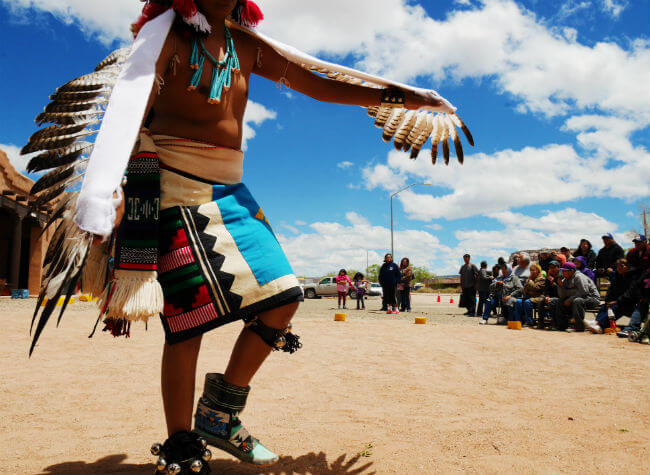
“Do you know the secret of the kachinas?”
It was a whispered question, between two young girls—one Zuni, one white—as they watched Zuni night dances in 1979.
Bronwyn Fox, then 9 years old, had moved to the town of Zuni in far western New Mexico for her mother’s teaching job. Fox found that, because of her age, she was treated like any of the other children and allowed to attend and participate in festivals and ceremonies, like the series of six night dances held each spring, that might otherwise be closed to a non-Zuni-member.
Fox remembers trying to deduce what her friend meant, but couldn’t muster a guess. “There’s a person inside the mask,” her friend replied, revealing the secret. Even as a young girl, this moment had a profound effect on Fox. “That really gave me perspective on how deep their religious beliefs were. It was powerful,” she says.
More than 30 years later, the Zuni tribe’s spring night dances still exude that strong sense of mystery and power that made such a lasting impression. In the dark of night, kachina dancers—men wearing intricate masks of feather, fur, shells, antlers, juniper bows, and leather—bounce to the steady rhythm of chanting and drum beats, moving in slow, oblong loops filling each room until nearly three in the morning. Some of the clown dancers, whose role is to inject humor into the long ceremonies, wear football jerseys, t-shirts, and camouflage. But for most, nothing about their regalia suggests the influence of modernity.
While the Zuni tribe, one of New Mexico’s 19 pueblos, has sustained many of the aesthetic aspects of its culture—including detailed artistry and intricate ceremonies—the deeper meaning and necessity that originally inspired and gave weight to those elements has been diluted by the influence of market capitalism and mainstream culture. Zuni people’s focus on beauty, which has long been a point of pride, has also become a source of income, and, as a result, some of the more serious, religious facets of their culture have faded. The pueblo’s six kivas—ceremonial rooms with an entrance hole in the ceiling that symbolize pueblos’ subterranean prehistory—are the foundation of the Zuni people’s spiritual world. Yet, since 1981, three of those kivas have suffered from neglect and have not been fully operational. The 10-day initiation ceremony, which involves the use of all six kivas and is instrumental in teaching Zuni youth the pueblo’s core values of community and devotion to collective prosperity, has not been practiced since then.
The Zuni tribe suffers from many of the same problems plaguing much of Indian Country: high unemployment, poverty, and insufficient education, among others. And although the dereliction and deterioration of the kivas isn’t the source of those issues, their repair could potentially be a solution. For the first time in more than 30 years, this prospect is a reality.
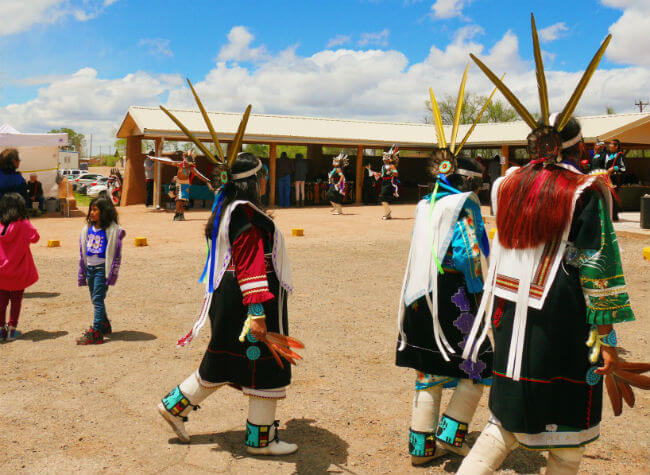
Dancers wearing brightly colored, traditional regalia walk past a dance in progress with artists selling crafts in the background.
Two years ago, Dan Simplicio attended his son’s initiation ceremony—an abbreviated version of the ceremony he experienced himself nearly 50 years earlier.
A former Zuni tribal councilor who works as a cultural specialist at Crow Canyon Archaeological Center in Cortez, Colo., Dan Simplicio’s experience that day was much different from what he remembered from his own initiation ceremony. Many of the initiates did not speak the Zuni language. Their gazes wandered about the kiva, and, among the increasing number of children who were not full-blooded Zuni, Dan Simplicio wondered how much they understood the meaning and weight of the ceremony.
A few months later, two of the new initiates were caught drawing blasphemous images of kachinas. (Depicting kachinas is generally prohibited.) For Dan Simplicio, the incident was unnerving, but he viewed it more as a symptom of a larger problem. “We’re not teaching the fundamental reasons of why we do this,” he says.
So Dan Simplicio has leveraged his position at Crow Canyon to work with the tribal administration to restore all three kivas—plus a fourth, which needs a new roof—as a way of reigniting among the Zuni people a more holistic and comprehensive attention to their culture. Having six operating kivas won’t solve every problem for the Zuni people, but Dan Simplicio believes it will spur broader change. Restoring the kivas, he says, can help rebalance Zunis who have lost their way within the intersection of the Western world and their own.
“For us, time is culture,” says Dan Simplicio. Or at least, that is how it used to be until the 1970s, when the U.S. Department of Housing and Urban Development (HUD) came to Zuni Pueblo, forcing people into single-family homes.
Before then, the tribe’s matriarchal society dictated that they live with extended families. As Noreen Simplicio, Dan Simplicio’s cousin and an award-winning potter, puts it, “We all ate, literally, from the same dish.”
But with the construction of single-family homes that are unable to accommodate traditional extended family living, this no longer takes place, and younger generations don’t have the benefit of nearby grandparents to pass down long-standing traditions and impart to them ancestral knowledge acquired over countless generations.
Before the HUD-spurred changes, home construction was a public event that reinforced close communal ties. But over the next decade, the federal government built more than 1,000 homes, which Zunis then had to purchase. This occurred across Indian Country, from the southern plains to Alaska, but it hit Zuni people and culture especially hard.
Because of the pueblo’s isolation, the Zuni had been somewhat withdrawn from the market economy, but with a sudden need for cash, they were thrust into America’s capitalist system. Jewelry, pottery, and fetishes—carvings of animals that are said to possess the spiritual qualities of the represented species—had always been central to their culture, and, with a growing demand for these items, many artists started selling their crafts in Gallup and other local markets. But like many poor communities, little infrastructure existed to help people manage their money. Few Zunis knew the value of the dollar, and, as a result, consumerism ran rampant and material possessions quickly became cheap status symbols.
From there, unintended consequences have spiraled. Individualism has replaced communalism, and privatization has divided people by introducing new conceptions of land ownership. Fences are now a common feature surrounding the town of Zuni. Alcoholism plagues many pueblo members, suicide rates are higher than they ever were, grisly murders have become far too routine, and, as Dan Simplicio sees it, the common thread that runs through them all ties back to the changes HUD brought to the pueblo.
While the Zuni people have retained many elements of their culture, especially those aesthetic aspects, the meaning behind some of these practices has been lost. For centuries, their arid location meant many of their ceremonies focused on bringing rain. Now, with flush toilets, running water, and ground water pumping, those ceremonies no longer mean what they once did.
Even Zuni artistry has been impacted. In the past, elder craftspeople frequently and enthusiastically taught and mentored young artists, but today, because an artist’s craft is directly tied to his or her livelihood, far fewer people are willing to tutor future artists and accusations of stealing or plagiarizing a particular style or technique have become regrettably commonplace. To counter this, Noreen Simplicio has taught at the high school and at summer camps. She now teaches at a substance abuse program, where she employs art as a medium to help former addicts regain their identity and learn a valuable trade. “It’s important that we not let it die out,” she says.
Meanwhile, Fox maintains a close connection to the Zuni people. She returned to Santa Fe in the early 1980s so her mother could manage Keshi, the Zuni Connection, a co-op formed by Zuni artists a few years earlier. At the pueblo’s insistence, her mother bought the store a few years after that but has since passed it on to her daughter. The store specializes in Zuni fetishes, jewelry, pottery, and other crafts, and Fox’s business model ensures that artists receive a fair price for their work. She is careful not to sell items considered to be ceremonial; wooden kachinas have become increasingly accepted, but the store won’t carry kachinas adorned with feathers, leather, or other clothing, as these are considered to be alive.
The sale and increasing popularity of fetishes also risks diluting the original meaning they have for Zuni members. Most Zunis who carry fetishes do so in small pouches and rarely, if ever, look at them, even ones they’ve owned for decades. “Fetishes in their ceremonial role in Zuni, you don’t see or hear much about,” says Fox. “It’s very personal.”
Although fetishes were originally designed as religious ornaments, their widespread popularity has transformed them into being predominantly artistic objects, and this has been a source of worry for some.
Jim Enote is a tribal member and the executive director of Ashiwi Awan Museum and Heritage Center, which bridges the gap between the pueblo’s past and future. Through the museum, he aims to enable Zuni people to understand how their past can inform their future. “It’s a contact zone for mediating knowledges,” he says, and for him this mode of learning could have important implications for Zunis to grasp how the influence of mainstream American culture has shaped their thinking on issues like agriculture, education, history, and language.
Enote sees more of a blurred line when it comes to what figures should and should not be sold. “There isn’t a cultural police,” he says. Enote is careful not to pass judgment on artists who rely on their work to make a living, but at the same time adds, “Some people think more critically about these issues than others. They can see the social impact of misrepresentation of Zuni images and figures.”
If for the Zuni people time equates to culture, then for the rest of America time is money. And to Dan Simplicio, Zunis are in limbo, unable to devote the necessary time needed to fully understand and practice their culture—the central problem to which all others are connected. “We can’t go back, but we’ve got to create balance,” he says.
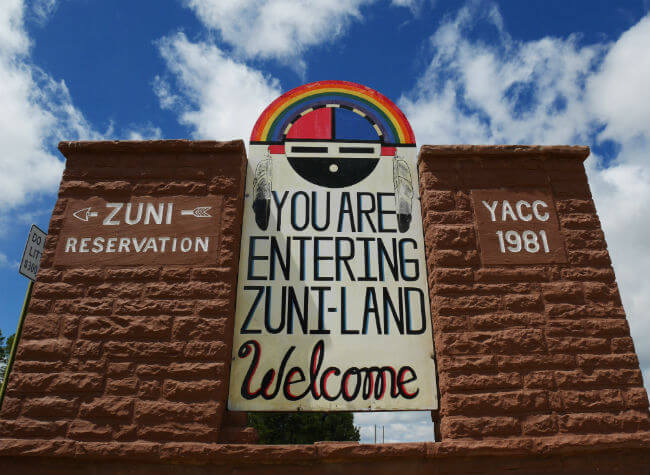
Zuni Reservation welcome sign.
To resurrect the full initiation ceremony, the kivas will be just one piece of the puzzle. Because 35 years have passed since the full ceremony was last performed, the first step will be conducting a detailed inventory of the living knowledge of it. That will help ensure the ceremony can be performed accurately. Once the inventory is complete, the kiva societies—the individual groups that oversee each of the six kivas and the ceremonies performed in each one—will supervise and complete the construction of their respective kivas.
This is not the first time that the pueblo has considered restoring the kivas, yet the necessary funding has never materialized. Enote would prefer that the kiva societies raise the money themselves, but so far those funds haven’t materialized.
And that’s where Crow Canyon, which uses archaeological research to educate and expand knowledge of Puebloan cultures, can play a role. By working with the tribal council and even HUD, which has recently allowed funds to be used for the construction of public buildings, Dan Simplicio looks forward to establishing a strong precedent. “We are creating a positive example that can help other pueblos with what we are doing here,” he says. “It’s the right direction.”
The director of the Zuni Heritage and Historic Preservation Office, Kurt Dongoske, agrees. “It’s a win-win for everyone,” he says. Not only have they avoided controversy, but as Dongoske, who is also a Zuni member, adds, “It’s a good example of collaboration between an outside group and the Zuni.”
It will also be the first major community construction event at Zuni Pueblo since HUD upended that practice more than 40 years ago.
Despite all of his work to reconnect his brethren with their traditional ceremonies and customs, Dan Simplicio doesn’t want the Zuni’s culture to be seen as stagnant. “We’re not here to be preserved,” he says.
Adds Noreen Simplicio, “We can never go back to our old ways, but we can remember.”
Instead, Dan Simplicio talks about continuance. If Zunis’ understanding of themselves is strongly rooted in a quest for aesthetic beauty, those roots extend much deeper. Prehistoric petroglyphs at the pueblo’s origin place in the Grand Canyon depict two people holding hands coming out of the emergence hole. “It’s not just a symbol of a helping hand,” Simplicio says. “It’s a symbol of never letting go.”
Michael J. Dax wrote this article for YES! Magazine. Michael is the author of Grizzly West: A Failed Attempt to Reintroduce Grizzly Bears in the Mountain West. He lives in Santa Fe, N.M., where he writes about the environment and the American West.

Indigenous Peoples are putting their bodies on the line and it's our responsibility to make sure you know why. That takes time, expertise and resources - and we're up against a constant tide of misinformation and distorted coverage. By supporting IC you're empowering the kind of journalism we need, at the moment we need it most.