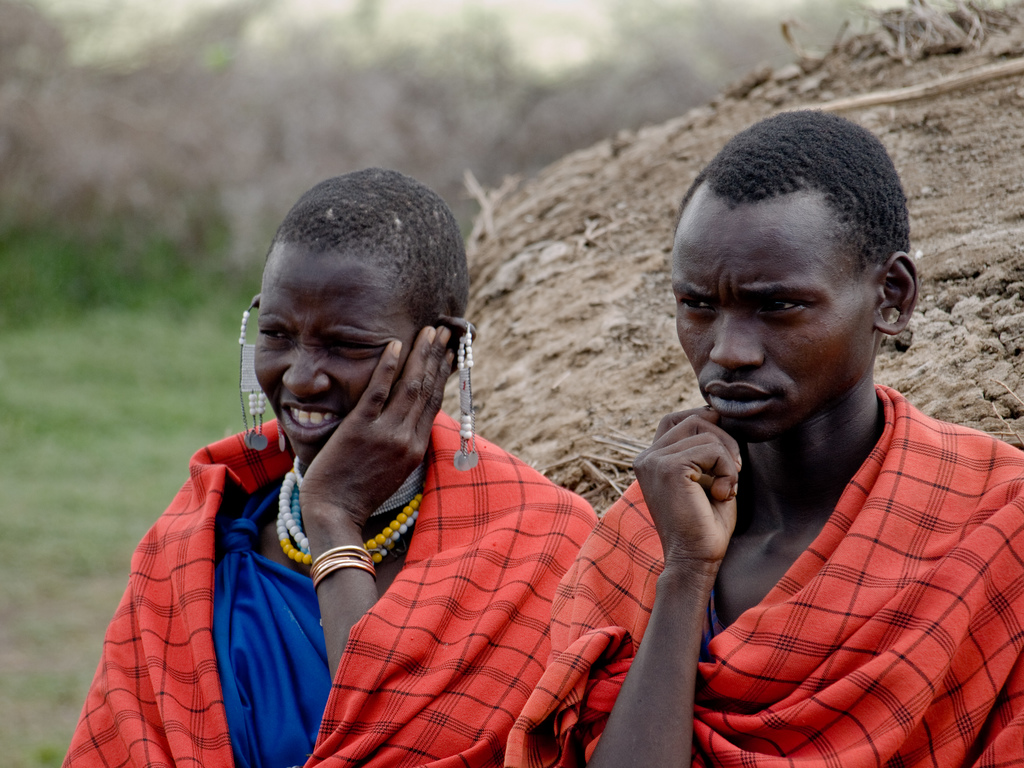
Despite years of outcry by international human rights institutions and local activists urging the government of Tanzania to recognize and respect indigenous rights, cases of systematic land alienation and forced evictions continue to be meted on indigenous people. Writing for Gáldu, Shadrack Kavilu reports.
Indigenous peoples’ ancestral land is mostly perceived by government as idle or underutilized and whenever there is a competing land use such as photographic tourism, hunting, large scale cultivation or hunting, indigenous peoples land is easily grabbed or leased to multinational companies to give room to more ‘economically viable’ investments.
The wide spread cases of violation of indigenous peoples rights in Tanzania has been blamed on lack of specific national policy or legislation on indigenous peoples.
The few enactments of law and amendments done in recent past does not reflect the interest of these indigenous people in terms of recognizing their identity and protecting their rights such as land and natural resources.
Over the years indigenous hunter-gatherer Hadzabe and Akie, and the pastoralist Barabaig and Maasai people have lost huge chunk of land to state authorities who hence convert it to game reserves, cultivation and mine fields.
Though violations of indigenous peoples’ rights are wide spread in Africa, some countries such as Congo Brazzaville have made significant steps in protecting the rights of these people.
Despite international pressure mounted on Tanzania to safeguard the rights of indigenous people, the country is yet to recognize them by enacting laws that safeguard, protect and promote their rights.
The country does not have a clear cut definition of who are indigenous people and thus all ethnic Tanzanians are regarded as indigenous.
Human rights activists attribute the forceful evictions and violation of indigenous people’s rights in the country to lack of legal and administrative measures that address the intrinsic link between land, identity and traditional culture.
The government has defied calls by several civil society organizations such as Hakiardhi, Pingo’s Forum, Cords, Taphgo, Ngonet, Alapa, Paicodeo, TNRF and Ujamaa CRT who have been in the forefront advocating for the enactment of laws that conform to the constitution and other international human rights instruments and standards.
Elifuraha Isaya Laltaika, the executive director of Association for Law and Advocacy for Pastoralist (ALAPA) and a law lecturer at the Makumira campus, Tumaini University in Arusha says lack of recognition of indigenous people has largely contributed to violation of indigenous people’s rights.
Laltaika says the government should come up with specific constitutional, legislative and administrative measures to protect rights of indigenous Peoples and ensure that they enjoy human rights in equal footing as other members of the mainstream society.
“Recognition is therefore a step in that it can lay the grounds for demanding legislative reforms as a distinct population,” he noted, adding that the enactment of laws that are negative on the livelihood systems of the indigenous peoples further undermine their rights.
According to submissions presented by a group of NGO’s to the Human Rights Council’s Universal Periodic Review (UPR) mid last year, it was apparent that indigenous populations in Tanzania are subjected to serious human rights violations.
In the submissions the human rights groups accused the government of violating indigenous peoples’ rights that include systematic land alienations, forced evictions, intimidations, marginalization from social services and lack of legal recognition.
They argued that justifications for these evictions have been unsubstantiated allegations that pastoralists cause environmental degradation, and that the government or local authorities need the lands of pastoralists and hunter-gatherers for investment purposes regardless of the traditional land ownership and customary practices.
The human rights groups urged the Human Rights Council to compel the government of Tanzania to establish legal and administrative measures that address, among others, the issue of identity and existence of indigenous people in the country.
The civil society group claimed in the submission that State authorities have been increasingly and arbitrarily dispossessing these indigenous peoples of their lands and other properties in order to protect the interests of investors.
The State authorities blamed for participating in denying the indigenous peoples’ rights include the Tanzania National Parks (TANAPA), Tanzania Investment Centre (TIC), Ngorongoro Conservation Area Authority (NCAA), Tanzania Peoples’ Defense Forces (TPDF) and District Commissioners.
The group further stated that in many eviction instances, the government had not intervened to safeguard the interests of the indigenous people while many evicted families were now landless, homeless and subjected to conflicts with other land users.
The human rights activists report noted that there was no legal framework in Tanzania for the promotion and protection of the rights of indigenous peoples, and that the country had not ratified the ILO Convention 169 concerning Indigenous and Tribal Peoples in Independent countries.
Article 26 of the ILO Convention Number 169 states that indigenous peoples’ have the right to the lands, territories and resources which they have traditionally owned, occupied or otherwise used or acquired and States should give legal recognition and protection to the same.
Sub-article three elaborates further that, such recognition shall be conducted with due respect to the customs, traditions and land tenure systems of the indigenous peoples concerned.
Though the government of Tanzania has been under intense pressure from both local and international civil organizations to recognise the rights of indigenous people, it has done very little to accord these people their rights.
On 27 March, 2007 the United Nations Committee on Elimination of Racial Discrimination (CERD) required the government of Tanzania to adopt legislative measure to recognize the specific rights of indigenous population living in Tanzania.
And on 29 July, 2009 the United Nations Human Rights Committee (HRC) also required the government to enact laws that would protect indigenous peoples’ rights.

Indigenous Peoples are putting their bodies on the line and it's our responsibility to make sure you know why. That takes time, expertise and resources - and we're up against a constant tide of misinformation and distorted coverage. By supporting IC you're empowering the kind of journalism we need, at the moment we need it most.