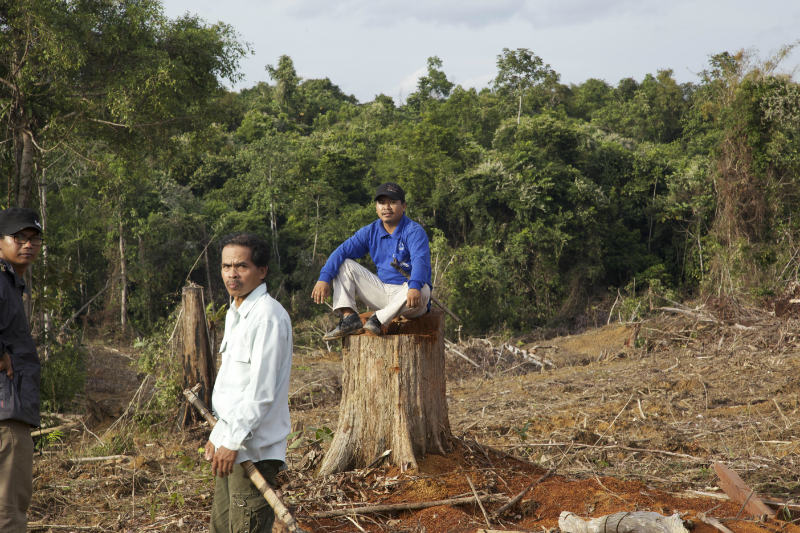
Deep in the interior of East Kalimantan, Indonesia, the Dayak community of Muara Tae is struggling to defend itself from a sustained assault by palm oil companies.
It’s Muara Tae’s last stand, warns Pak Singko, a traditional leader from the Dayak community, who is now turning to the international community for support. “This is the last remaining forests that we have and the only land we have to survive. If my forests are gone, our lives will end.”
Below, a press release from the UK-based Environmental Investigation Agency concerning Muara Tae’s struggle.
PRESS RELEASE
TUESDAY, JANUARY 24, 2012 – FOR IMMEDIATE RELEASE
Dayak community under assault from invading palm oil companies
MUARA TAE, EAST KALIMANTAN: The fate of a Dayak community deep in the interior of East Kalimantan demonstrates how Indonesia must safeguard the rights of indigenous people if it is to meet ambitious targets to reduce emissions from deforestation.
The Dayak Benuaq of Muara Tae, in West Kutai Kabupaten, today face a two-pronged assault from palm oil companies aggressively expanding into their ancestral forests. Together with Indonesian NGO Telapak, the community is manning a forest outpost around the clock in a last ditch attempt to save it from destruction.
The London-based Environmental Investigation Agency (EIA) has witnessed at first-hand the Dayak Benuaq’s struggle, and how their sustainable use of forests could help Indonesia deliver on its ambitious targets to reduce greenhouse gas emissions.
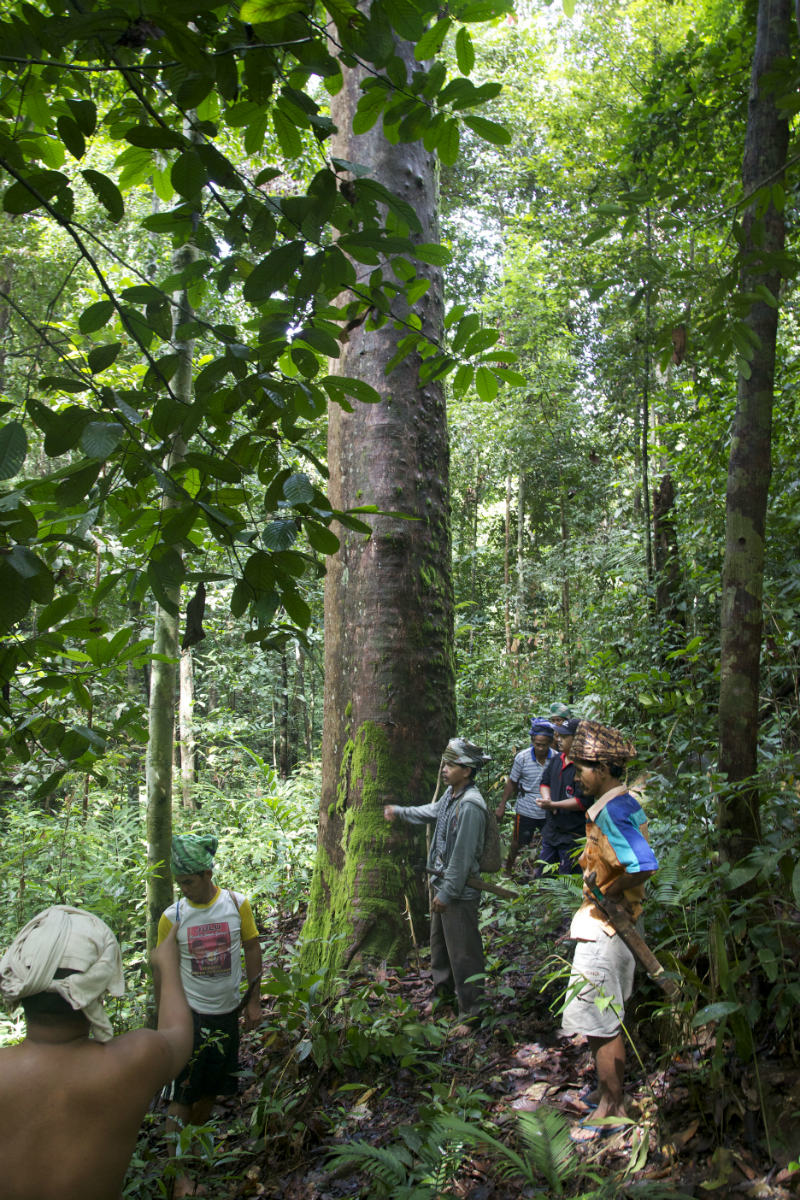 Asuy, Masrani, Singko, Sedan, leaders of Indigenous Peoples of Muara Tae formed a ceremony to invoke the spirit of the Ulin Tree to protect their forests (credit: EIA/Tom Johnson)EIA Forests Team Leader Faith Doherty said: “There are more than 800 families in Muara Tae relying on the forests for their food, water, medicine, culture and identity. Put simply, they have to keep this forest in order to survive.
“The rhetoric from the President of Indonesia on curbing emissions by reducing deforestation is strong but on the front line, where indigenous communities are putting their lives at risk to protect forests, action is sorely missing.
“Giving these communities, such as the Dayak Benuaq, the rights they deserve is a vital step to reduce catastrophic levels of deforestation in Indonesia.”
President Yudhoyono has pledged to reduce carbon emissions across the archipelago by 26 per cent by 2020 against a business-as-usual baseline, alongside delivering substantial economic growth.
Plantation expansion will inevitably be a significant element of growth, but it has historically been a major driver of emissions and it is widely acknowledged that in order avoid them, expansion must now be directed to ‘degraded’ lands.
As a result of weak spatial planning, however, the forests of Muara Tae are identified as ‘APL’, a designation meaning they are not part of the national forest area and are open to exploitation. The theft of indigenous forests also raises serious questions as to what form of ‘development’ these plantations offer.
In indigenous communities such as the Dayak Benuaq of Muara Tae, Indonesia has perhaps its most valuable forest resource. It is due to their sustainable methods, honed over generations, that the forest even remains.
Telapak president Ambrosius Ruwindrijarto said: “Together with the community, we have not only been protecting the last forests but also planting new Ulin and Meranti saplings to enhance it. These people are the true guardians of the forest and their fate is entwined with it.”
Muara Tae has lost more than half of its land and forests during the past 20 years to mining companies. The impact has been tangible; the villagers’ water source has dried up and they must now routinely make a 1km journey to collect clean water.
The remaining forest is home to a large number of bird species including hornbills, the emblem of Borneo. There are about 20 species of reptiles and it is also a habitat for both proboscis monkeys and honey bears.
The latest land-grabs have taken place since January 2010, when the local Bupati (regional government official), Ismail Thomas, issued plantation permits to two palm oil companies: Malaysian-owned PT Munte Waniq Jaya Perkasa (PT MWJP) and PT Borneo Surya Mining Jaya, a subsidiary of Sumatran logging, mining and plantation conglomerate Surya Dumai.
While the Norwegian Government has been instrumental in financially backing efforts to reduce deforestation in Indonesia through the REDD+ initiative, it has also invested in the parent company of PT MWJP through its sovereign wealth fund.
Pak Singko, a leader of the Dayak Benuaq of Muara Tae, said: “We are calling for help from people everywhere in protecting our forests and ancestral land. We are being squeezed from all sides by mining and plantation companies.
“This is the last remaining forests that we have and the only land we have to survive. If my forests are gone, our lives will end.”
New images and interviews are available on request from:
• EIA Forests Team Leader Faith Doherty via faithdoherty@eia-international.org, telephone +62 812875 31771
• EIA senior campaigner Jago Wadley on jagowadley@eia-international.org, telephone +44 20 7354 7960
• Telapak Director Ambrosius Ruwindrijarto on mbajing@telapak.org, telephone +62 81111 02208
• Telapak Forests Campaign Co-ordinator Abu Meridian on abu.meridian@gmail.com, telephone +62 857157 66732
EDITORS’ NOTES
1. The Environmental Investigation Agency (EIA) is a UK-based Non Governmental Organisation and charitable trust (registered charity number 1040615) that investigates and campaigns against a wide range of environmental crimes, including illegal wildlife trade, illegal logging, hazardous waste, and trade in climate and ozone-altering chemicals.
2. Telapak is an independent environmental organisation based in Bogor, Indonesia. Visit www.telapak.org for more information.
3. Read further background to the conflict in Muara Tae at http://www.eia-international.org/villagers-face-off-against-palm-oil-firms-bulldozers

Indigenous Peoples are putting their bodies on the line and it's our responsibility to make sure you know why. That takes time, expertise and resources - and we're up against a constant tide of misinformation and distorted coverage. By supporting IC you're empowering the kind of journalism we need, at the moment we need it most.