Indigenous News for Saturday, July 4

Broken Rainbow (Forced Relocation of the Navajo)

November 8, 2008 at 12:07pm | 1,398 views and 2 comments, leave your own

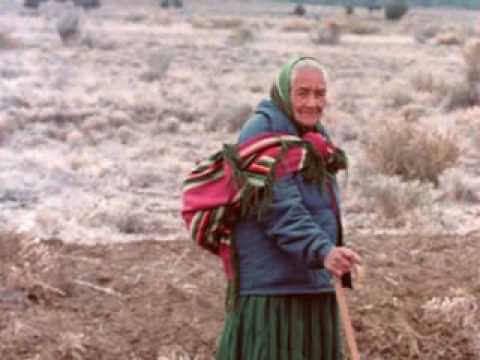
Broken Rainbow is a 1985 documentary film about the industry-led and government-enforced relocation of more than 10,000 Navajo from their traditional lands.

On December 1974 Congress passed “The Navajo-Hopi Land Settlement Act” which authorized the partitioning of the Joint Use Area (JUA) of the Navajo and Hopi Nations, and established the Navajo-Hopi Indian Relocation Commission (NHIRC) which led the relocation.

Soon after, countless of the most traditional and culturally-intact Dineh (Navajo) people were stripped from the only world they knew — and thrown into a cold and rootless way of life.

This documentary traces the events that led to this devastating relocation – as well as the history of both the Hopi and Navajo Nations, who’s dispute over land was used by the government to justify it.

Indeed, the government claimed that the relocation was to help bring an end to that dispute. The real reason, however, was to open up the region for coal and uranium exploitation.

The forced relocation of the Navajo continues to this day.

Broken Rainbow (Part 1 of 7)

Filed Under

2 Comments on "Broken Rainbow (Forced Relocation of the Navajo)"

  1. Kathryn says:

    It is good that this film continues to enlighten many on the living conditions of the Navajo people. Although some “progress” has been made pertaining to the results of the Navajo-Hopi Land Settlement Act, not a lot of real changes have occurred.
    When the Government determined to re-divide the Joint Use Area once (semi)peacefully shared by the Hopi & Navajo Nations through the 1974 Settlement Act, they decided they would determine to move Navajo families as well as Hopi families onto property already used by other families living well below poverty level. They also decided that it was a good idea to severely decrease and limit livestock, be it the sheep so precious to Navajo survival or horses, or any other creature that a BIA (Dept. of Interior created Bureau of Indian Affairs) employee determined to be out of scope for the family. If the families did not get rid of the livestock that the BIA determined was over the limit, the BIA would just come and take them.
    Of course there was also the construction ban, imposed by former U.S. commissioner of Indian Affairs, Robert Bennett that would not permit ANY alteration to an existing building (25 year old hogans included). What became known as the Bennett Freeze banned absolutely any “improvements” such as holes in the roof, walls, or floors.
    The families that were “relocated” were given money to find a new place. Perhaps a couple grand with which to attempt to move on to some one elses property, to share what ever small amount of water may come their way or shrubbery that must be fed to what livestock they were left with. Or they were taken to cheaply built housing put up by a company that did not stay in business for long after. The housing included sinks, bath facilities, electric appliances, electric heat and electric hot water tanks. Oh. But they seemed not to get around to the electricity aspect. Or the water.

    Curious about the “progress” mentioned earlier?
    That would be on the western side of the Reservation. After all this time, the Construction freeze implemented by Robert Bennett was finally lifted in 2006 after the Hopi & Navajo Nations came to an agreement, and the BIA is allotting funding for a study to determine what should be done next.

    Progress. The Navajo in the Bennet Freeze area are in for another frozen winter.

  2. Kathryn,

    thank you for this update. Much appreciated. Do you have any current relevant links I could post on my channel to keep us in touch with what’s happening in real time?

    Google has a lot of them, but I’m looking for the most recent and credible sources. The stuff out there is all over the place.

Have your say